

When debt and investing combine
Speaking very broadly, finance contains two businesses: moving money and storing money. The moving business is glamorous, highly paid, and attracts many of the brightest graduates. Its practitioners tend to be sociable, wear expensive silk ties and scarves, and drive premium German cars.
The storage business is steadier and more conservative. Its people are generally less well-paid, more cautious, and look at their sandals when they talk to their clients. They do not drive flashy cars; a second-hand Volvo is as much excitement as they can take.
The storage business is represented by the wealth and asset management industry. These firms take clients’ money, invest it and look after it for years, often decades. They earn a small percentage of the assets they manage, so their revenues tend to grow gradually alongside their clients’ wealth. Companies such as BlackRock, Vanguard, and Callanish Capital fit this description.
The moving business serves the storage business. When an asset manager wishes to buy or sell shares, bonds, derivatives or foreign currency, it uses a broker or investment bank. These firms also help companies raise capital by issuing shares or bonds. Their revenues depend largely on transaction volumes: the more money changes hands, the more they earn. Goldman Sachs, Bank of America, and JPMorgan are examples of investment banks, although they also have asset management businesses.
These are, of course, light-hearted caricatures. There is, however, one corner of the storage business that is more exciting: hedge funds. Originally, hedge funds sought to select attractive stocks while offsetting market risk through short positions, investments that make money when the market falls. By hedging out broad market movements, managers relied more heavily on stock-picking skill. Because such skill is scarce, hedge funds were able to charge high fees, traditionally around 2% of assets plus 20% of any profits. This is known as a “Two-and-Twenty” structure.
To enhance returns, many hedge funds also borrow money from large investment banks. A fund with $100 of capital might borrow a further $100 and invest $200. This leverage magnifies gains but also magnifies losses. For the investment banks, the arrangement is attractive because they earn both lending fees and double the transaction revenues. Because the lending is secured against the assets of the hedge fund, the credit risk is generally low. This is the collateral for the loan. The units in the investment banks servicing hedge funds became very lucrative, and are now known as prime brokers.
If losses erode a fund’s capital, the prime broker may demand additional collateral, known as a margin call, or require positions to be reduced and the borrowing to be repaid. For example, if a leveraged hedge fund with $100 of capital and $100 of debt loses $40, its equity falls from $100 to $60 while the loan remains $100. This might make the lender feel nervous. Before the loss, the prime broker had a $100 loan secured by $100 of capital; after the loss, there is only a $60 cushion supporting that exposure. The broker might therefore make a margin call of $40 on the hedge fund investors, or ask that $40 of hedge fund investments be liquidated to repay part of the loan and restore the 1:1 collateral cushion.
To reduce the risk of margin calls or forced liquidation, most hedge funds employ prudent investment strategies and sophisticated risk systems. Yet every few years, somebody concludes that the old rules no longer apply. They always do.
This appears to have happened in just the last few weeks to Situational Awareness, the hedge fund run by 24-year-old Leopold Aschenbrenner. Although details remain sketchy, young Leopold correctly identified the AI infrastructure boom and reportedly built a fund that peaked at around $40 billion in assets by June 2026, probably including approximately $20 billion of borrowing from prime brokers. The Financial Times reported that the fund returned an amazing 439% after fees in the year to June 2026, or 550% grossed up for fees.
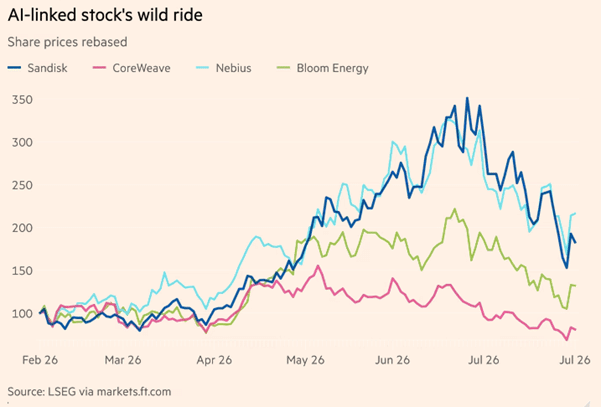
Those exceptional returns seem to have been driven by large, concentrated investments in AI infrastructure companies such as SanDisk, CoreWeave, Bloom Energy, and Nebius, imperfectly hedged by bearish bets on semiconductor stocks such as Nvidia, Micron and Broadcom. Broad diversification across the market seems to have been forgotten about.
Such aggressive strategies can work brilliantly while markets rise. However, after extraordinary gains of several hundred per cent in April and May in some of the AI infrastructure stocks, there were sharp declines in July 2026 (see chart below). As the overall market was stable, this should not have been a problem, but because the portfolio was concentrated in a small sector and leveraged, the impact on the fund was catastrophic.
The remarkable thing is that Situational Awareness may yet prove broadly correct about the future of artificial intelligence. A good investment thesis, however, is not enough. Investors must also survive the journey. Being early, over-concentrated and highly leveraged can be just as dangerous as being wrong.
The resulting losses appear to have triggered margin calls that the fund struggled to meet, forcing the liquidation of many positions into a weak market. Those sales likely intensified the damage. By 3 August, Situational Awareness had sold most of its listed positions and shrunk from $40 billion to about $10 billion, mainly invested in unlisted companies. It is possible that investors who gained 439% in the year to June gave back most of their profits a few weeks later.
Fortunately, there appears to have been little wider market fallout. Nevertheless, the episode is a powerful reminder that debt and investing are an inherently risky combination. Doubly so today as smaller retail investors now have access to ETFs with embedded borrowing, offering two or three times the daily return of certain stocks, commodities or indices. Such products have legitimate uses, but they require a level of discipline and risk management that many retail investors underestimate. For many investors, they transform an investment product into a speculative trading instrument.
The collapse of Situational Awareness brings to mind an observation often attributed to Walter Wriston, former Chairman of Citicorp, commenting on earlier bank crises: successful banks, he said, need the “fear of God” to survive. The Fear of God is clearly still alive and well among Situational Awareness’s prime brokers, who moved quickly and efficiently when things turned sour. The people in the moving business are, perhaps, just a little brighter and a little more ruthless. When there is a stock market boom, as there is in America, caution may be unfashionable. Yet investment success is not measured by the highest peak reached, but by what remains after the storm. Being right about the future is not enough. Investors who borrow heavily rarely get credit for being right eventually if they cannot survive being wrong temporarily.

Please be aware that the value of investments may go up or down and you may receive back less than you invested originally. Past performance is not a guide to the future.
This document contains general information only and does not provide any advice or guidance specific to your personal circumstances.
Callanish Capital is authorised and regulated by the Financial Conduct Authority to manage investments and authorised to provide advice on investments, pensions, credit, protection and mortgages.
This email and any accompanying attachment are issued by Callanish Capital Ltd, a company registered in England and Wales under company number 13182424. Registered Office: 45 Pont Street, London, SW1X 0BD.
Callanish Capital Ltd is a Discretionary Fund Manager, directly authorised and regulated by the Financial Conduct Authority (“FCA”) under registration number 955992.