
From Roman coins to modern inflation
Money has three functions in classical economics. It acts as a means of exchange, a unit of account and a store of value. To fulfil these roles, money must be trusted. Yet throughout history governments have faced a recurring temptation. When spending outstripped tax revenues, they have often chosen to reduce the value of money rather than cut expenditure or raise taxes.
The methods have changed, but the incentives remain remarkably similar. Roman emperors debased their silver coinage by mixing precious metals with cheaper alternatives. Today, governments no longer alter the silver or gold content of coins, but inflation can achieve a similar outcome by eroding the purchasing power of money and reducing the real burden of outstanding debt.
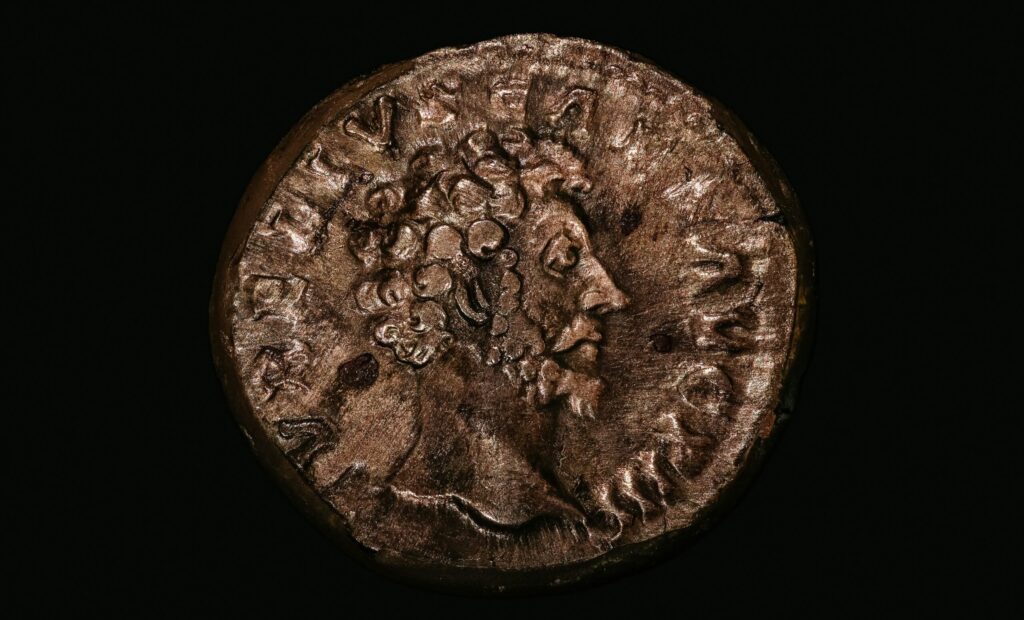
The Roman silver denarius was introduced around 211BC and represented about one day’s wage for a skilled workman. At its birth it contained about 95% silver and remained largely unchanged for almost four centuries. However, after 200 AD successive emperors, including Septimius Severus, Caracalla and Aurelian, progressively debased the coin until it contained less than 5% silver by 275 AD.
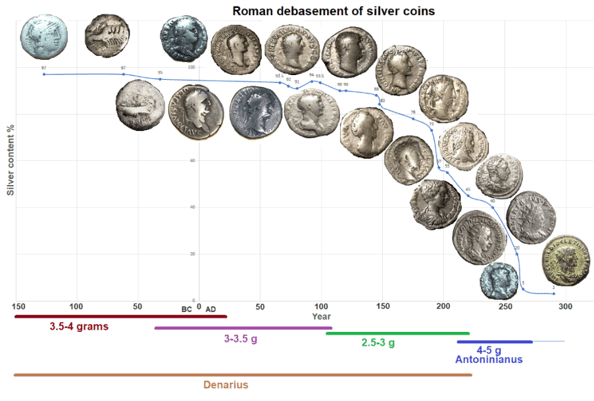
Emperors had troops to keep loyal, a bureaucracy to pay, public works to maintain and free grain distributions, known as the annona, to fund. To make all this affordable, the Roman emperors successively reduced the silver content of the denarius to make their money go further without raising taxes.
The acceleration of the debasements coincided with the long-term decline in imperial trade around 200 AD, as measured by the number of shipwrecks, the volume of pottery traded around the Empire and evidence from Egyptian papyrus records. As higher-quality silver coins disappeared from circulation and were hoarded or melted down, lower-quality coins increasingly dominated transactions, an effect later described by Sir Thomas Gresham as ‘bad money driving out good’.
A shortage of money and a higher rate of saving/hoarding would have reduced economic activity, making it harder for the emperors to collect taxes and creating a vicious circle of lower revenues and further debasements. Price increases accompanied the debasements, but the most severe inflation emerged after 250 AD, adding to the strife at the time and possibly contributing to the weakening of the state.
The people most hit by the debasements would have been workers paid largely in debased coinage. Urban workers were particularly vulnerable as they had to exchange their debased coinage for food imported from the countryside. The wealthy, who may have owned farms, productive workshops or precious metals, were relatively better off as incomes and prices adjusted to the falling value of the denarius.
Although the mechanism has changed, the underlying political incentives remain remarkably similar. We no longer have gold and silver coins and now rely on paper money issued and controlled by central government. Governments can no longer reduce the silver content of our money, but they can allow higher inflation to help reduce the burden of debt in real terms. Nobel Prize winner James Buchanan believed that democracy is particularly prone to inflation as politicians make unfunded promises they cannot keep or pay for. The UK provides a recent example. Over the past decade, consumer price inflation, despite a formal target of 2% per annum, has reduced the real value of outstanding government debt by more than 40%. Viewed from the other side of the balance sheet, it has also eroded conventional gilt investors’ capital by a similar magnitude in real terms.
Unlike Roman currency debasement, modern inflation tends to hit those whose savings are concentrated in cash, who are often lower paid or less financially sophisticated. When inflation is high real incomes tend to be squeezed leading to declining living standards among the most vulnerable. Inflation is often associated with exchange rate instability and with higher interest rates which tend to stifle economic activity and undermine confidence and investment in the future. A by-product might also be industrial strife as labour unions push to restore workers’ incomes, which can further undermine confidence and increase pressure on governments.
Inflation means that money is a very poor store of value. Occasionally, governments’ management of money is so poor, and inflation so high, that money loses its role as a means of exchange and a unit of account. This happened in Germany in the early 1920s. Although the Weimar Republic survived the hyperinflation itself, the episode left a lasting psychological scar and weakened confidence in democratic institutions. More recently the populations of Zimbabwe, Cambodia, Lebanon and Venezuela have abandoned their local currencies in favour of the US dollar.
While the nature of money has changed from something containing value to something representing value, the political incentives surrounding it have proved remarkably persistent. Roman emperors debased the denarius to fund armies, public works and grain distributions without raising taxes. Modern governments no longer reduce the silver content of coins, but inflation can still reduce the real burden of public debt and other spending commitments. The mechanism has changed, but the temptation remains. History suggests that confidence in money is one of the foundations of economic prosperity and political stability. When governments undermine that confidence, whether through debasement or inflation, the economic and political risks can be severe. For investors, it is a reminder that preserving purchasing power often matters more than preserving nominal capital.
Please be aware that the value of investments may go up or down and you may receive back less than you invested originally. Past performance is not a guide to the future.
This document contains general information only and does not provide any advice or guidance specific to your personal circumstances.
Callanish Capital is authorised and regulated by the Financial Conduct Authority to manage investments and authorised to provide advice on investments, pensions, credit, protection and mortgages.
This email and any accompanying attachment are issued by Callanish Capital Ltd, a company registered in England and Wales under company number 13182424. Registered Office: 45 Pont Street, London, SW1X 0BD.
Callanish Capital Ltd is a Discretionary Fund Manager, directly authorised and regulated by the Financial Conduct Authority (“FCA”) under registration number 955992.